Lens matched to the room
We select a lens from your actual throw distance so the projector can sit where it is safe and out of sightlines.
High brightness for ballrooms and auditoriums
High-brightness and laser projectors with interchangeable lenses for ballrooms, auditoriums, churches, general sessions, and concerts.
At a glance
RentOurProjectors.com rents large venue projectors in roughly the 7,000 to 20,000+ lumen range for ballrooms, auditoriums, churches, and general sessions. These projectors usually pair with a large fast-fold screen, a lens chosen for your throw distance, and a technician who handles setup, alignment, and the show itself. Share your venue, audience size, and screen plans and we will specify the system.
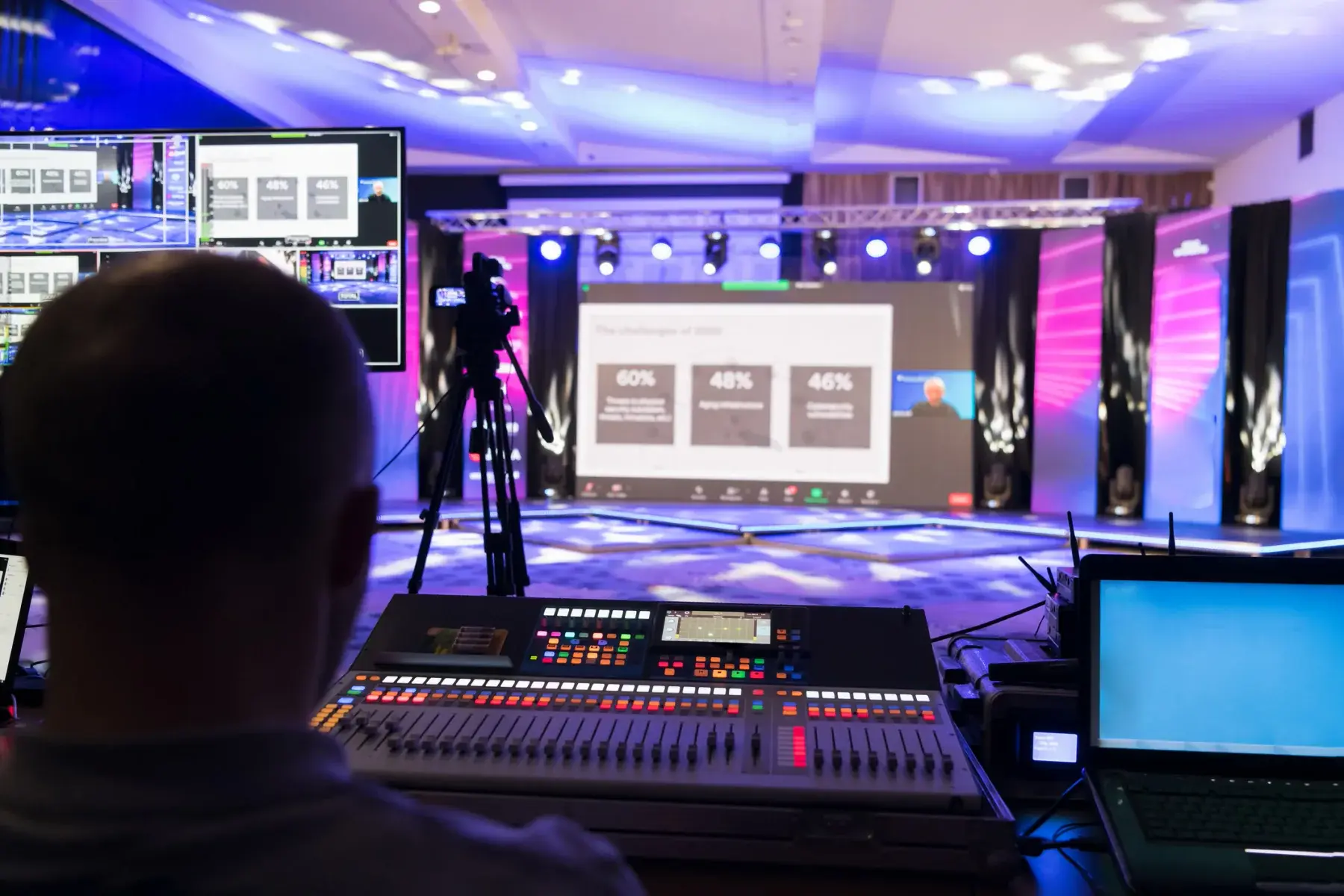
Once an audience grows past about 75 people, or the screen grows past 10 or 12 feet wide, a standard meeting room projector starts to look washed out. Large venue projectors deliver the brightness needed to fill a big screen in a ballroom or auditorium: roughly 6,000 to 10,000 lumens for audiences of 75 to 200, and 10,000 to 20,000 lumens or more for 200 to 500+ people, bright rooms, or very large screens.
Many projectors in this class use a laser light source, which turns on and off instantly, holds consistent brightness through a long event, and avoids lamp changes. They also accept interchangeable lenses, so the projector can sit at the back of the room, in a balcony, or on a short riser near the stage and still produce the exact image size you need. Lens shift lets the image be moved up, down, or sideways without tilting the projector and distorting the picture.
For extra-wide screens, two or more projectors can be edge blended into one seamless image. Blending, rigging, and stacking are specialized work, so we recommend scheduling a technician for nearly every large venue rental.
| Typical brightness | 7,000 to 20,000+ ANSI lumens |
|---|---|
| Best audience size | About 75 to 500+ people |
| Common screen sizes | 9x16 ft to 10.5x18 ft fast-fold, or larger |
| Light source | Laser or high-output lamp |
| Throw distance | Set by interchangeable lens, short to long throw |
| Setup time | Often 1 to 3 hours with a technician |
| Power | Dedicated circuit recommended |
General guidance. Your quote confirms the exact equipment for your room, audience, and dates. Try the projector calculator for your own numbers.
Why it works
We select a lens from your actual throw distance so the projector can sit where it is safe and out of sightlines.
Laser models reach full brightness quickly and stay consistent across long general sessions and multi-day events.
Heavy projectors need sturdy stands, scaffolding, or truss handled by people who know the venue's rules.
An on-site technician aligns the image, manages sources, and stays through the show to handle changes.
Planning guide
The three numbers that drive the design are screen size, throw distance, and ambient light. Screen size comes from the room: a 200-person ballroom typically needs a screen in the 9x16 to 10.5x18 foot range so the back rows can read text. Throw distance is measured from the projector position to the screen, and it determines which lens is required. Ambient light from house lights, stage wash, or windows often decides whether you need 10,000 lumens or closer to 20,000.
Think about where the projector will physically live. Front projection from a riser or stand in the middle of the room is simple but takes up floor space and needs cable runs covered with ramps or gaffer tape. Rear projection keeps equipment out of sight and prevents presenter shadows, but needs open depth behind the screen. Flying a projector from truss is possible in many venues, but it requires certified rigging and venue approval, so raise it early.
Large projectors draw significant power and should not share a circuit with catering equipment or lighting. Ask the venue which circuits are available near the projector position. When you request a quote, include the venue name, room dimensions or a floor plan, audience count, screen preference, and the event schedule including rehearsal time.
Availability and exact models vary. Your quote confirms the equipment, accessories, and delivery plan for your dates. Want to go deeper first? Read our projector planning guides or the projector rental FAQ.
For a dark ballroom with 75 to 200 guests, 6,000 to 10,000 lumens is a common starting point. Larger audiences, very wide screens, or rooms where house lights stay up during the program usually call for 10,000 to 20,000 lumens or more.
Ballrooms and auditoriums vary widely in depth, so a single fixed lens cannot fit every room. Swapping lenses lets the projector sit at the back of the room, in a booth, or close to the stage and still fill the screen exactly.
Edge blending uses two or more projectors with slightly overlapping images that are electronically feathered together. The result is one wide, seamless picture that would be too large or too dim for a single projector.
We strongly recommend it. Lens selection, alignment, stacking or blending, and source switching during the program are easier and safer with an experienced technician on site.
Some can, but high-brightness models draw enough power that a dedicated circuit is the safer choice. Check with the venue's facilities team about available circuits near the projector location.
Compare projector options
Tripod, fast-fold front and rear projection, and inflatable outdoor screens in a range of sizes, with dress kits and drapes available.
View rentals →
1080p, WUXGA, and 4K UHD projectors for detailed graphics, design and engineering reviews, medical content, video, and film screenings.
View rentals →
LCD and DLP projectors in the 3,000 to 6,000 lumen range for conference rooms, training rooms, offices, and small events.
View rentals →Free, no-obligation quote
Tell us the occasion, audience size, location, and date. We will recommend the right projector, screen, and sound, and send a quote built around your event.