No beam in the presenter's eyes
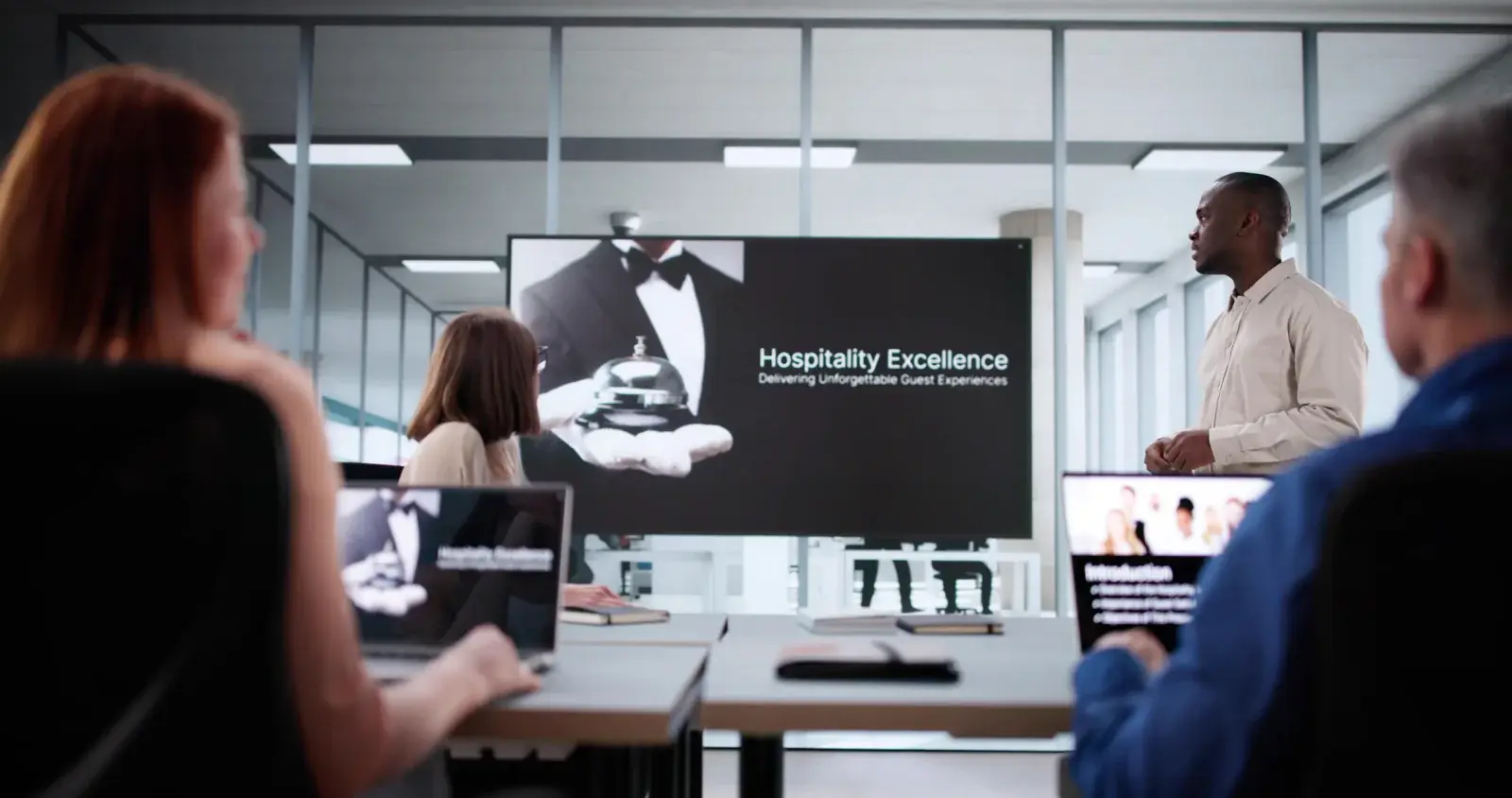
With the projector close to the screen, speakers can face the audience without being blinded by the lamp.
Big images from close distances
Short throw and ultra short throw projectors that create large images from just a few feet away, ideal for tight rooms, booths, and interactive setups.
At a glance
RentOurProjectors.com rents short throw and ultra short throw projectors for spaces where a standard projector would have to sit too far back. A short throw model can produce a large image from just a few feet away, and an ultra short throw model can sit almost against the screen wall. Send us your room depth and desired image width and we will confirm which type fits.
Throw ratio is the throw distance divided by the image width. A standard projector with a 1.5:1 ratio needs about 15 feet of distance to create a 10-foot-wide image. A short throw projector, typically in the 0.4:1 to 1.0:1 range, can create that same image from about 4 to 10 feet. Ultra short throw projectors, with ratios under 0.4:1, sit only inches to a couple of feet from the wall or screen.
Getting the projector close to the screen solves several common problems. Presenters can walk up to the screen without casting large shadows or staring into a bright beam. The projector stays out of walkways and away from guests in crowded rooms. Booths and small rooms that simply do not have 15 feet of depth can still show a big picture.
Short throw projectors are also popular for interactive setups, where people touch, point at, or write near the projected image. Placing the light source above or just in front of the surface keeps hands and bodies from blocking the picture.
| Throw ratio | Short throw about 0.4 to 1.0:1; ultra short throw under 0.4:1 |
|---|---|
| Throw distance | Inches to roughly 10 feet, depending on model and image size |
| Typical brightness | About 3,000 to 5,000 ANSI lumens |
| Best audience size | About 5 to 50 people |
| Common screen sizes | 6 to 10 feet wide |
| Setup time | About 20 to 40 minutes, including alignment |
| Power | One standard grounded outlet |
General guidance. Your quote confirms the exact equipment for your room, audience, and dates. Try the projector calculator for your own numbers.
Why it works
With the projector close to the screen, speakers can face the audience without being blinded by the lamp.
Presenters and participants can stand near the image without blocking most of it.
Small offices, booths, and narrow rooms can still show a large picture without moving furniture.
Fewer cables crossing aisles and no projector cart in the middle of the room.
Planning guide
To choose the right model, measure two things: how wide you want the image, and how much distance you have between the screen surface and where the projector can sit. Divide the distance by the image width to get the throw ratio you need. If the answer is between about 0.4 and 1.0, a short throw projector fits. If it is under 0.4, you need an ultra short throw model.
Ultra short throw projectors project at a steep upward angle, so the screen surface must be very flat. Any wrinkle or wave in a fabric screen becomes obvious. A rigid wall, a tensioned screen, or a fast-fold frame pulled tight works best. Also plan a stable surface directly below or in front of the screen, such as a low table or cabinet, so the projector does not get bumped out of alignment.
In trade show booths, short throw projectors can shine onto rear walls or back-lit graphics without anyone walking through the beam. Tell us the booth size, wall height, and whether the projector can sit on the floor, on a counter, or mounted to the structure, and we will plan the placement.
Availability and exact models vary. Your quote confirms the equipment, accessories, and delivery plan for your dates. Want to go deeper first? Read our projector planning guides or the projector rental FAQ.
It depends on the throw ratio and image size. A 0.5:1 short throw projector creates an 8-foot-wide image from about 4 feet away. An ultra short throw model can sit within inches to a couple of feet of the screen.
Yes. Booths rarely have the depth for a standard projector, and short throw models keep the beam out of the walkway so visitors do not cast shadows or look into the light.
It needs a very flat surface. Because the light hits at a steep angle, wrinkles in a loose fabric screen become visible. A rigid wall or a tensioned screen gives the cleanest image.
Many short throw models fall in the 3,000 to 5,000 lumen range, which suits small and medium rooms. For a large hall, a standard or large venue projector with a short throw lens is usually a better choice.
Compare projector options
LCD and DLP projectors in the 3,000 to 6,000 lumen range for conference rooms, training rooms, offices, and small events.
View rentals →
Tripod, fast-fold front and rear projection, and inflatable outdoor screens in a range of sizes, with dress kits and drapes available.
View rentals →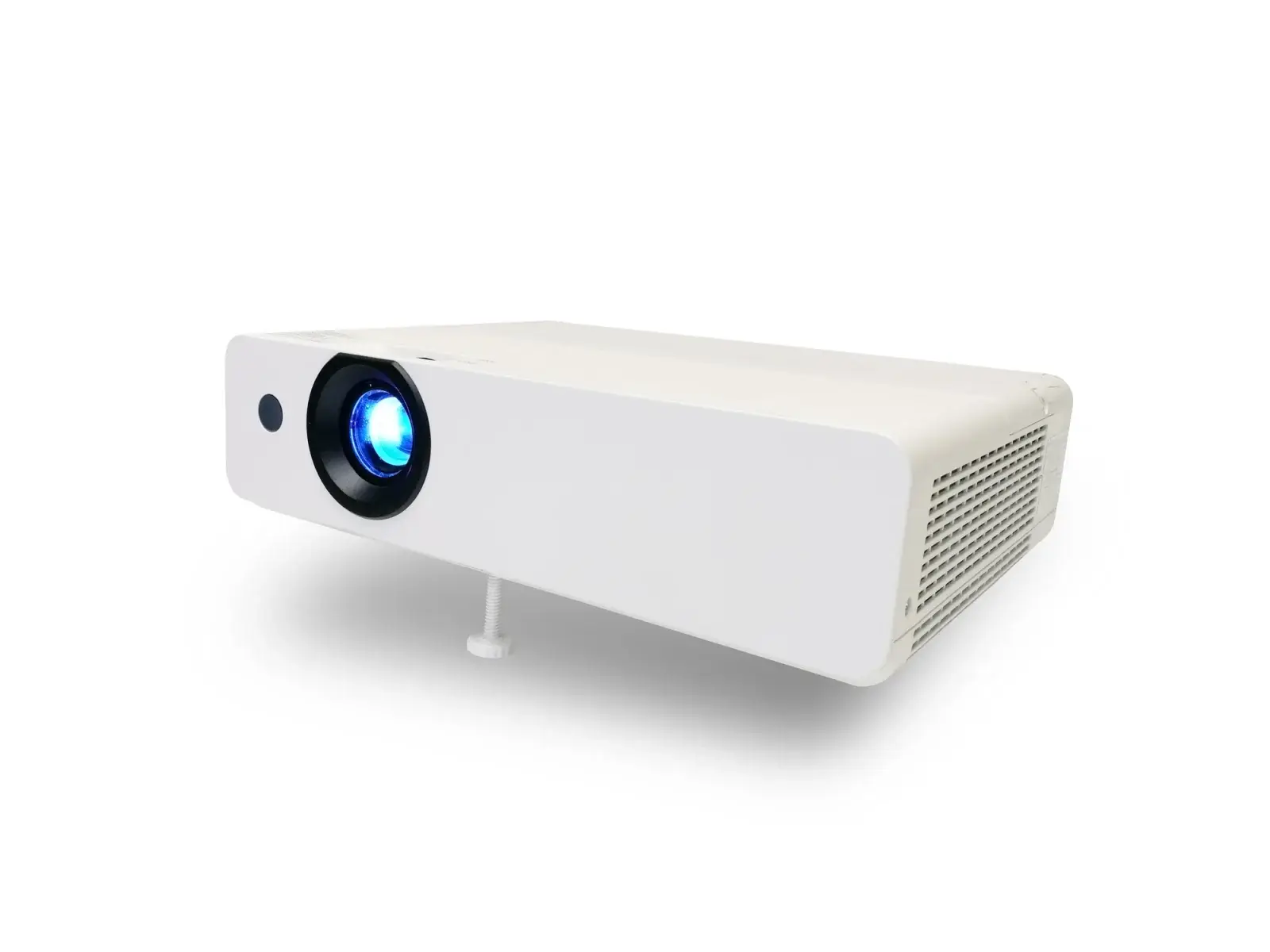
Compact and mini projectors for sales calls, traveling trainers, small team meetings, and pop-up sessions where portability matters most.
View rentals →Free, no-obligation quote
Tell us the occasion, audience size, location, and date. We will recommend the right projector, screen, and sound, and send a quote built around your event.